How to use this guide
This guide is written in plain English for UAE business owners, finance teams and compliance officers. Use the table of contents on the right to jump to a specific section, or read straight through for a full picture. Have a question specific to your business? Book a free consultation with our team using the buttons at the bottom of this page.
At a glance
Overview
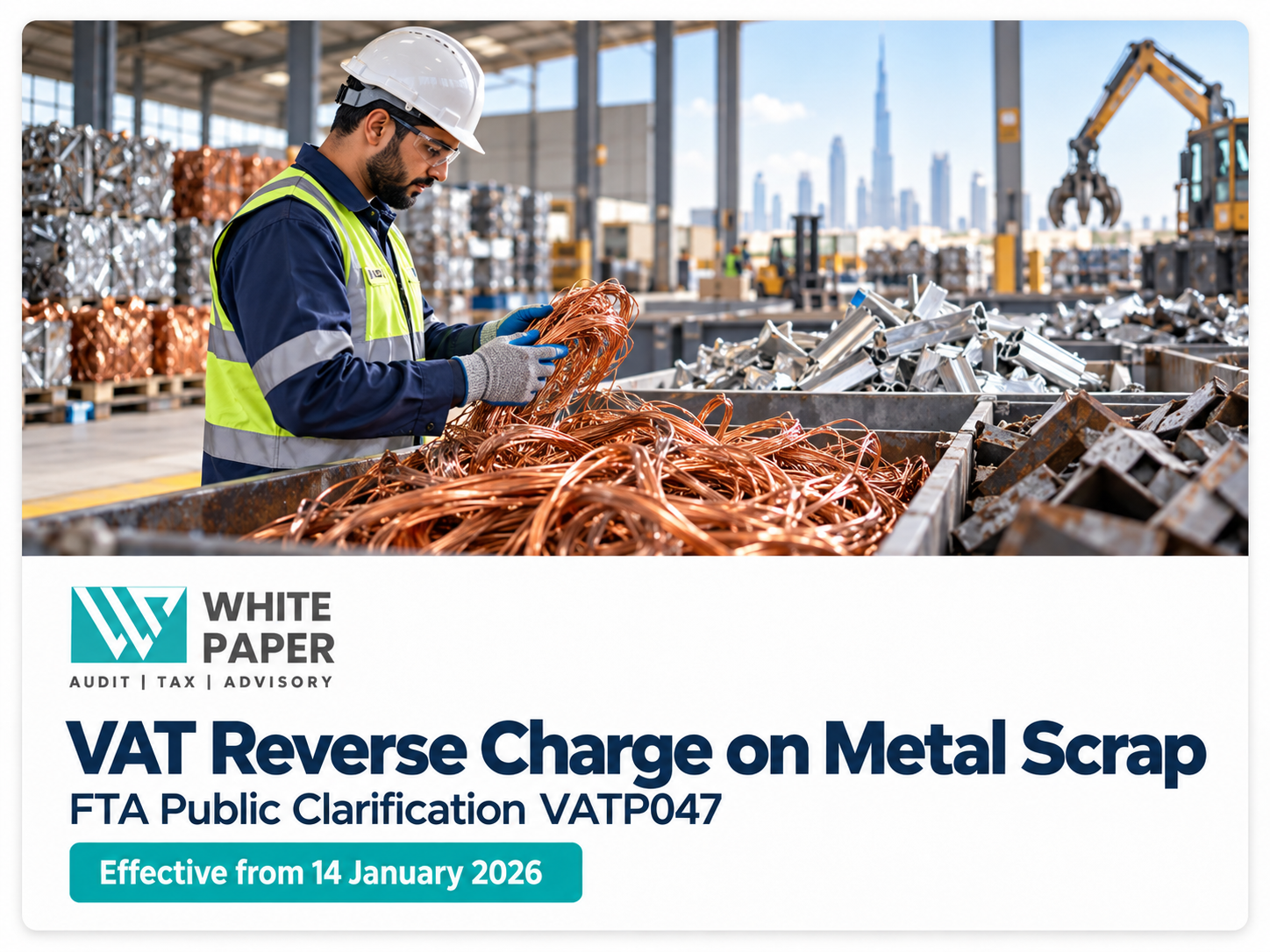
The UAE Federal Tax Authority (FTA) issued VAT Public Clarification VATP047 in October 2026 to explain how the Reverse Charge Mechanism applies to qualifying metal scrap transactions between VAT-registered businesses in the UAE.
Businesses dealing in metal scrap should review their customer declarations, Tax Registration Number (TRN) verification procedures, tax invoices and VAT return reporting. A failure to satisfy the required conditions can change the VAT treatment of the transaction and may prevent the recipient from recovering the related input VAT.
What is the Reverse Charge Mechanism?
Under the normal VAT rules, a supplier charges VAT on a taxable supply, collects it from the customer and reports the output tax in its VAT return.
Under the Reverse Charge Mechanism, the responsibility for accounting for VAT moves from the supplier to the recipient. For a qualifying metal scrap transaction:
- The supplier does not charge VAT on the supply.
- The recipient accounts for the VAT under the Reverse Charge Mechanism.
- The recipient may recover the VAT as recoverable tax, subject to the normal input-tax recovery rules and the specific requirements explained in VATP047.
The Reverse Charge Mechanism applies only when all prescribed eligibility and documentation conditions are satisfied.
Which Goods are Treated as Metal Scrap?
VATP047 defines metal scrap as ferrous or non-ferrous metal waste that has commercial value and can be used following processing.
This may include goods that mainly consist of qualifying metal material. For example, a used lead-acid battery that has reached the end of its useful life may be treated as metal scrap where lead forms the majority of its composition and is the main component to be extracted through processing.
The special treatment does not extend to every type of scrap. The following materials remain subject to the normal VAT rules:
- Paper
- Plastic
- Glass
- Textiles
- Organic waste
- Rubber
Mixed or composite scrap
Which Transactions Qualify?
The Reverse Charge Mechanism applies when all of the following conditions are met:
- The supplier provides qualifying metal scrap to the recipient.
- Both the supplier and the recipient are registered for UAE VAT.
- The recipient purchases the metal scrap with the intention of reselling it or using it in processing.
- The recipient provides the required written declarations to the supplier before the date of supply.
- The supplier verifies the recipient's VAT registration through the FTA's TRN verification facility.
- The supplier retains the required declarations and issues a compliant tax invoice stating that the Reverse Charge Mechanism applies.
If any required condition is not satisfied, the normal VAT treatment may apply.
What Do “Resale” and “Processing” Mean?
Resale
Resale means selling the metal scrap as part of the recipient's business of trading in that scrap. The resale may take place at wholesale or retail level.
Metal scrap purchased for another internal business purpose is not treated as having been purchased for resale. For example, scrap metal acquired for repairing storage racks, fences or structural supports at the recipient's premises would not satisfy the resale condition.
Processing
Processing means converting metal scrap into material that can be used to manufacture new products. This may take place through repairing, recycling or another conversion method.
For example, metal scrap acquired for conversion into construction material, building products or new vehicle parts may satisfy the processing condition.
Recipient's Compliance Responsibilities
Before the date of supply, the recipient must provide the supplier with written confirmation that:
- The recipient is registered for VAT, including its TRN.
- The metal scrap is being purchased for resale or for use in processing.
The two confirmations may be combined into one declaration.
Timing matters
The recipient must then account for VAT on the qualifying transaction and comply with the applicable VAT return reporting requirements.
Supplier's Compliance Responsibilities
Before applying the Reverse Charge Mechanism, the supplier should:
- Receive and retain the recipient's written declarations.
- Verify the recipient's VAT registration using the FTA's TRN verification facility.
- Retain evidence of the verification as part of the transaction records.
- Clearly state on the tax invoice that the supply of metal scrap is subject to the Reverse Charge Mechanism.
The supplier should not rely only on a TRN printed on a purchase order or communicated informally. The FTA clarification specifically requires the supplier to verify the recipient's registration.
How Should the Transaction Be Reported in the VAT Return?
Where all eligibility requirements are satisfied, the reporting treatment is as follows:
| Party | VAT-Return Treatment |
|---|---|
| Supplier | Does not account for VAT and does not report the qualifying metal scrap supply or related VAT in its VAT return. |
| Recipient | Accounts for the supply in Box 3 of the VAT return. |
| Recipient's recovery | May recover the recoverable tax in Box 10, subject to the applicable recovery conditions. Box 9 should not be used for this transaction. |
System configuration
When Does the Special Treatment Not Apply?
The metal scrap Reverse Charge Mechanism does not apply in several situations, including where:
- The goods do not meet the definition of metal scrap.
- Either party is not registered for VAT.
- The recipient does not intend to resell or process the metal scrap.
- The recipient purchases the scrap for internal use other than processing.
- The required declarations are not provided before the date of supply.
- The supplier makes a qualifying direct or indirect export of metal scrap.
Where a direct or indirect export meets the conditions for zero-rating, the normal VAT rules apply and the supplier reports the transaction as a zero-rated supply.
What Happens if the Declarations are Missing?
If the recipient does not provide the required declarations before the date of supply, the Reverse Charge Mechanism conditions are not met.
In that situation:
- The supplier must apply VAT at the standard rate.
- The supplier reports the supply in Box 1 of its VAT return.
- According to VATP047, the recipient is not eligible to recover the input VAT incurred on that purchase.
Documentation is not optional
Practical Example
Emirates Metal Trading LLC, a VAT-registered business, purchases copper scrap from another UAE VAT-registered supplier for resale to industrial processors.
Before the date of supply, Emirates Metal Trading LLC gives the supplier a written declaration confirming its TRN and stating that the copper scrap is being purchased for resale. The supplier verifies the TRN through the FTA facility and issues a tax invoice stating that the Reverse Charge Mechanism applies.
In this case:
- The supplier does not charge VAT.
- The recipient accounts for VAT in Box 3.
- The recipient may recover the eligible amount in Box 10.
If the declaration had not been provided before the date of supply, the supplier would instead charge VAT at the standard rate and report the transaction in Box 1. The recipient would not be entitled to recover that VAT under the treatment explained in VATP047.
Compliance Checklist for Metal Scrap Businesses
For Suppliers
- Confirm that the goods qualify as metal scrap.
- Establish the recipient's intended use of the goods.
- Obtain the recipient's written declarations before the date of supply.
- Verify the recipient's TRN through the FTA facility.
- Retain the declarations and verification evidence.
- Include the Reverse Charge Mechanism statement on the tax invoice.
- Apply the correct accounting and VAT-return tax code.
For Recipients
- Confirm that the purchase is genuinely for resale or processing.
- Provide the required declarations before the date of supply.
- Give the supplier accurate VAT-registration information.
- Account for the transaction in Box 3.
- Claim eligible recoverable tax in Box 10, not Box 9.
- Retain purchase, declaration, invoice and processing or resale records.
Key takeaway
How WPAA Can Help
White Paper Accounts Auditing can assist businesses with:
- Reviewing metal scrap transactions and VAT treatment
- Preparing recipient declaration templates
- Checking tax-invoice wording
- Reviewing accounting-system VAT codes
- Reconciling VAT return Boxes 1, 3, 9 and 10
- Conducting VAT compliance reviews before filing
Tailored advice
Official Reference
- UAE Federal Tax Authority — VAT Public Clarification VATP047: Application of the Reverse Charge Mechanism on Metal Scrap Trading among UAE VAT Registrants (October 2026).
- Cabinet Decision No. 153 of 2025.
Last reviewed: October 2026.
Disclaimer
Need help with VAT?
Book a free 30-minute consultation with our team. We'll review your specific situation and flag anything worth acting on.
Disclaimer
This guide is provided for general informational purposes only and should not be considered accounting, tax, legal, or professional advice. Please consult White Paper Accounts Auditing (WPAA) or another qualified professional before acting on any information contained in this guide.