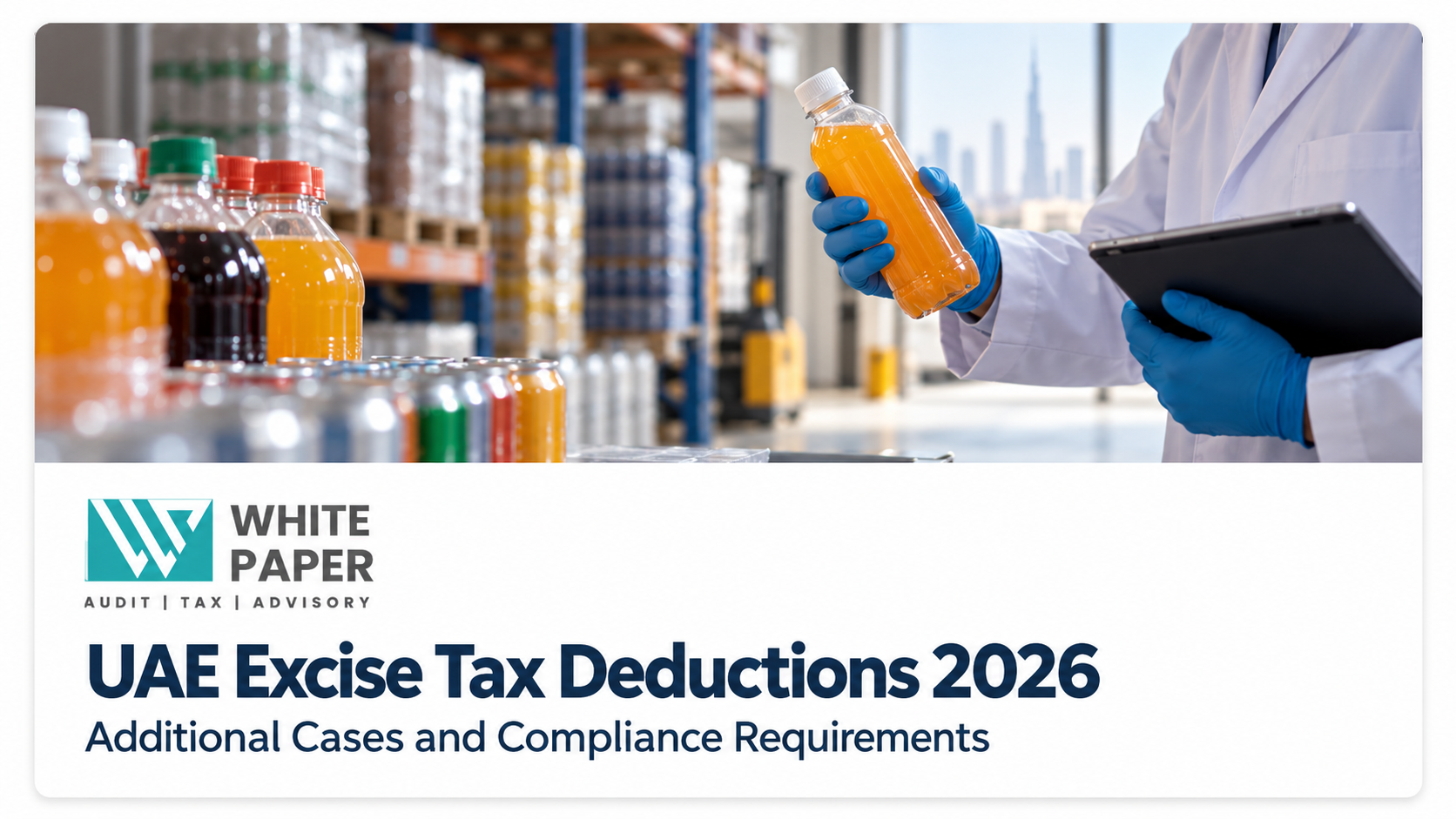
UAE Excise Tax Deductions in 2026: Additional Cases and Compliance Requirements
FTA Decision No. 11 of 2025, effective 1 January 2026, introduces two additional cases where Excise Tax previously paid may be deducted — damaged inspection samples in Designated Zones and excess tax on reclassified sweetened drinks. Both come with strict conditions and evidence requirements.
The UAE Excise Tax framework was updated with the issuance of Federal Tax Authority Decision No. 11 of 2025, which identifies two additional situations in which Excise Tax previously paid may be deducted. The Decision was issued on 12 December 2025 and became effective on 1 January 2026.
The new provisions are relevant mainly to taxable persons and warehouse keepers dealing with Excise Goods in Designated Zones, as well as businesses handling sweetened drinks affected by the UAE's updated Excise Tax classification system.
These deductions are not automatic. Businesses must satisfy the specific conditions in the Decision and retain the prescribed supporting evidence. This article explains the two additional cases, the applicable controls and the practical steps businesses should consider.
What Does FTA Decision No. 11 of 2025 Cover?
The Decision introduces the following additional cases in which Excise Tax may be deducted:
- Tax paid on a sample of Excise Goods removed from a Designated Zone for an inspection to determine the permissible natural-shortage percentage, where the sample is damaged during the inspection and becomes irrecoverable.
- Excess Excise Tax paid on sweetened drinks initially classified in the High-Sugar Category, where an accredited laboratory report subsequently establishes that the drinks belong to a lower category or are not subject to Excise Tax.
Each case has separate eligibility conditions and documentary requirements.
Case 1: Samples Damaged During Natural Shortage Inspection
The first additional deduction applies in a narrowly defined situation involving Excise Goods held within a Designated Zone.
To qualify, all the following conditions must be satisfied:
- A sample of the Excise Goods must be removed from the Designated Zone exclusively for inspection by an Independent Competent Entity.
- The purpose of the inspection must be to determine the percentage of natural shortage arising from the production or storage process, in accordance with FTA Decision No. 6 of 2025.
- The sample must be damaged during the inspection.
- The damage must make the sample irrecoverable, meaning it cannot be returned to the Designated Zone.
- The Warehouse Keeper or Taxable Person must retain and submit the evidence required by the FTA when requesting the deduction.
The supporting evidence must be issued by the Independent Competent Entity and must state:
- The quantity of Excise Goods removed from the Designated Zone
- That the goods were removed to determine the natural-shortage percentage
- That the goods were damaged during inspection and became irrecoverable
Practical example
A warehouse keeper arranges for an Independent Competent Entity to test a sample of Excise Goods stored in a Designated Zone to determine the permissible natural-shortage percentage. The testing process consumes or damages the sample, making it impossible to return the sample to the Designated Zone. If the prescribed evidence is obtained and the other conditions are satisfied, the Excise Tax paid on that sample may be deductible.
Important limitation
The Decision does not provide a general deduction for every natural shortage, leakage, evaporation, stock loss or damaged product. It specifically covers a sample removed for the prescribed inspection where that sample is damaged during the inspection and becomes irrecoverable. Other shortages, losses or damaged goods must be considered separately under the wider Excise Tax legislation and applicable FTA procedures.
Case 2: Excess Tax Paid on Reclassified Sweetened Drinks
The second additional case provides temporary relief for certain sweetened drinks initially classified under the High-Sugar Category.
Under the Decision, the High-Sugar Category covers sweetened drinks containing 8 grams or more of total sugar and other sweeteners per 100 milliliters of the drink.
A Taxable Person may deduct excess Excise Tax previously paid under the High-Sugar Category when a qualifying laboratory report establishes that the drink:
- Falls within a lower category based on its sugar and other-sweetener content
- Is not subject to Excise Tax
This relief applies only to tax periods commencing on or after 1 January 2026 and ending on or before 30 June 2026.
Conditions for the deduction
The Taxable Person must satisfy both of the following requirements:
- The sweetened drinks must not have been sold before the date on which the right to deduct arose.
- The required documentary evidence must be submitted when making the deduction request.
The required evidence consists of:
- A laboratory report establishing that the sugar and other-sweetener content is below the High-Sugar Category, or that the drink is not subject to Excise Tax
- A copy of the declaration previously submitted through the FTA's system confirming that tax was paid according to the High-Sugar Category
- Evidence demonstrating that the relevant goods had not been sold before the right to deduct arose
For this purpose, the laboratory report must be issued by a laboratory accredited in accordance with the list published by the Ministry of Industry and Advanced Technology (MoIAT).
Practical example
A beverage business initially declares an unsold sweetened drink under the High-Sugar Category and pays Excise Tax accordingly. An accredited laboratory report subsequently confirms that the drink's total sugar and other-sweetener content is below 8 grams per 100 millilitres and therefore falls within a lower category. If the claim concerns an eligible tax period ending no later than 30 June 2026 and the business submits all prescribed evidence, the excess Excise Tax may be deducted.
Deduction Is Not the Same as a General Refund
Businesses should distinguish between a deduction permitted in an Excise Tax return or deduction request and a general cash-refund entitlement. FTA Decision No. 11 of 2025 identifies additional cases where tax already paid may be deducted, subject to specific controls. It should not be interpreted as creating an unrestricted right to a refund for damaged, lost or incorrectly classified goods.
The correct treatment will depend on the facts, the relevant tax period, the status of the goods and the available supporting evidence.
Compliance Checklist for Businesses
Businesses considering a deduction under the Decision should review the following points before proceeding:
- Confirm that the goods and circumstances fall within one of the two cases stated in Article 2 of the Decision.
- Identify the relevant tax period and confirm that any sweetened-drink reclassification falls within the temporary period ending on 30 June 2026.
- Confirm that sweetened drinks included in a proposed deduction were not sold before the right to deduct arose.
- Use a laboratory accredited in accordance with the MoIAT list where a sweetened-drink laboratory report is required.
- Obtain complete evidence from the Independent Competent Entity for any sample damaged during a natural-shortage inspection.
- Reconcile the proposed deduction with the original Excise Tax declaration and accounting records.
- Retain a clear audit trail linking the goods, quantities, tax paid, inspection or laboratory results and the deduction claimed.
- Review the applicable FTA procedure before submitting the deduction request.
Common Mistakes to Avoid
Businesses should avoid the following assumptions:
- Treating all damaged stock or natural shortages as automatically deductible
- Claiming a deduction merely because goods were removed from a Designated Zone
- Using a laboratory report from a laboratory that does not meet the applicable accreditation requirements
- Claiming excess tax on sweetened drinks that had already been sold before the deduction right arose
- Applying the temporary sweetened-drink relief outside the specified tax periods
- Failing to reconcile the deduction with the declaration through which the original Excise Tax was paid
- Submitting a claim without the evidence expressly required by the Decision
How WPAA Can Assist
White Paper Accounts Auditing LLC SP can assist businesses in assessing whether a proposed Excise Tax deduction falls within the applicable legal provisions. Our support may include:
- Reviewing eligibility under FTA Decision No. 11 of 2025
- Checking laboratory reports and supporting records
- Reconciling proposed deductions with previously submitted declarations
- Reviewing Designated Zone and warehouse documentation
- Preparing an audit-ready supporting-document file
- Assisting with Excise Tax compliance and reporting procedures
Early review is particularly important for sweetened-drink reclassification because the deduction provision applies only to a limited transitional period.
Frequently Asked Questions
When did FTA Decision No. 11 of 2025 become effective?
The Decision became effective on 1 January 2026.
Can Excise Tax be deducted for any goods damaged outside a Designated Zone?
Not under the first additional case in this Decision. That case specifically concerns an Excise Goods sample removed from a Designated Zone for an approved natural-shortage inspection and damaged during that inspection so that it becomes irrecoverable.
Does the Decision allow a deduction for ordinary evaporation or leakage?
It does not create a general deduction for ordinary evaporation, leakage or stock loss. The additional case concerns the tax paid on a sample used in the prescribed inspection process. Natural-shortage treatment must otherwise be assessed under the relevant Excise Tax rules, including FTA Decision No. 6 of 2025.
What is considered a High-Sugar Category sweetened drink?
For this Decision, it is a sweetened drink containing at least 8 grams of total sugar and other sweeteners per 100 milliliters.
Can a business claim the sweetened-drink deduction after selling the goods?
The Decision requires that the Taxable Person must not have sold the drinks before the date on which the right to deduct arose.
How long is the sweetened-drink transitional deduction available?
It applies to tax periods commencing on or after 1 January 2026 and ending on or before 30 June 2026, subject to all other conditions being met.
Conclusion
FTA Decision No. 11 of 2025 provides targeted relief in two specific circumstances: irrecoverable samples damaged during prescribed natural-shortage inspections and excess tax paid on qualifying reclassified sweetened drinks.
The Decision should be applied carefully. Eligibility depends on the precise facts, the relevant tax period and the availability of the required evidence. Businesses should therefore review their records and obtain advice before including a deduction in their Excise Tax reporting.
Disclaimer
This article is intended for general informational purposes only and does not constitute tax, legal or professional advice. The application of UAE Excise Tax rules depends on the specific facts and circumstances of each case. Businesses should refer to the official legislation and obtain professional advice before taking any action.
Official Source
- Federal Tax Authority Decision No. 11 of 2025 — Additional Cases Where Excise Tax Paid on Excise Goods May Be Deducted and Controls for Such Deduction