
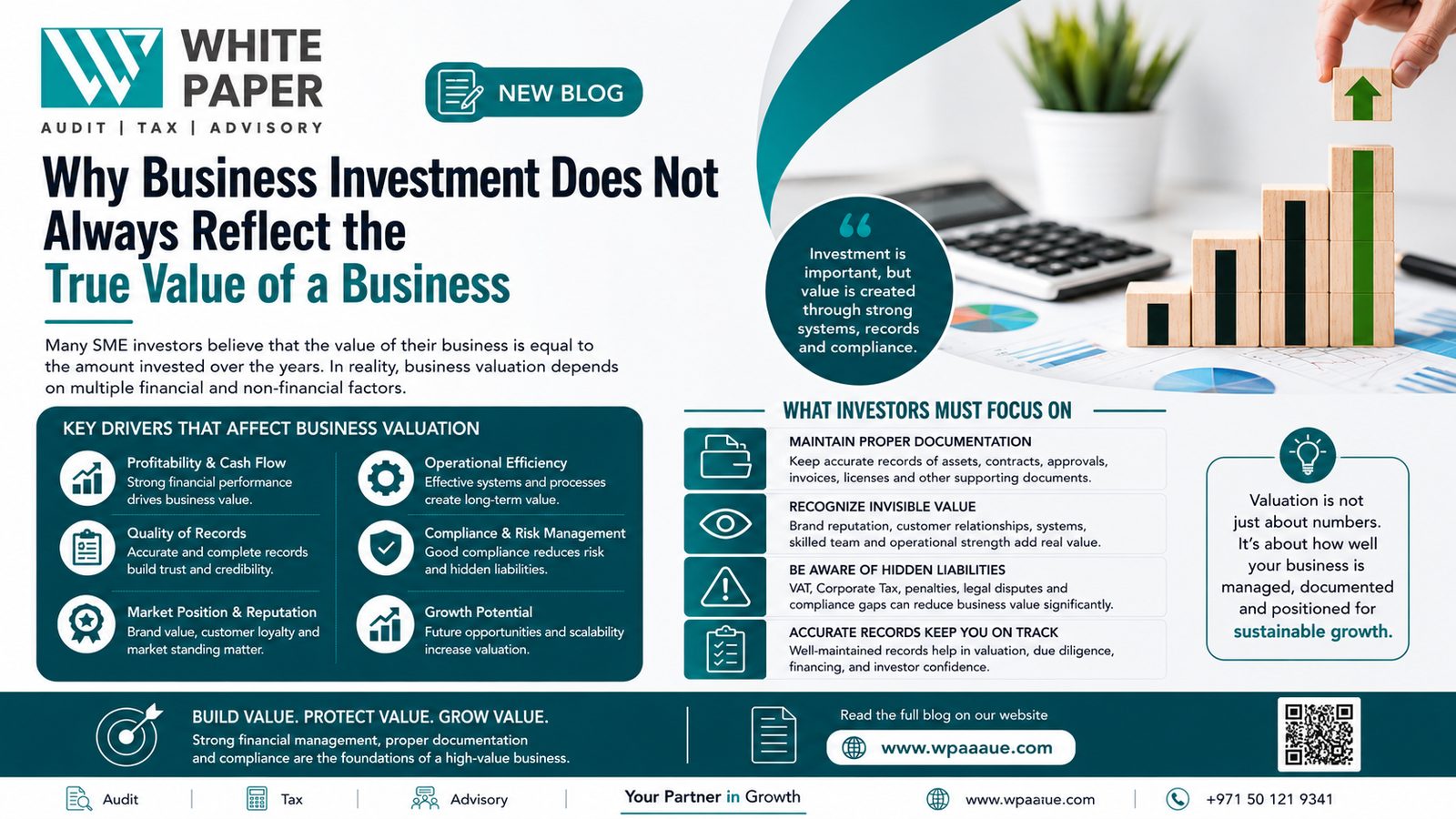
Why Business Investment Does Not Always Reflect the True Value of a Business
Many investors assume their business is worth the amount invested over the years. In reality, valuation depends on profitability, records, compliance, systems, and reputation — not capital spend alone.
When business owners and SME investors think about the value of their company, many assume that the business is worth the total amount invested over the years. While investment plays an important role, actual business valuation is far more complex.
In reality, the value of a business depends on multiple financial, operational, legal, and strategic factors. A company that has received significant investment may still have low market value, while another business with moderate investment may hold strong valuation due to profitability, systems, brand reputation, and growth potential.
For SMEs in the UAE and other competitive markets, understanding the real drivers of business valuation is essential for sustainable growth, investor confidence, succession planning, mergers, fundraising, or future business exits.
Understanding Business Valuation
Business valuation is the process of determining the economic worth of a company based on available information, financial performance, market conditions, risks, and future potential.
The valuation of a business can increase or decrease depending on several factors, including:
- Profitability and cash flow
- Quality of accounting records
- Market position
- Customer relationships
- Compliance history
- Operational systems
- Asset ownership and documentation
- Future growth opportunities
- Industry risks
- Legal and tax exposures
This means that two businesses with similar investment amounts can have completely different market values.
Why Investment Amount Alone Does Not Define Business Value
Many investors spend years injecting capital into their businesses through:
- Infrastructure development
- Equipment purchases
- Marketing expenses
- Employee costs
- Technology implementation
- Expansion activities
However, spending money does not automatically create value.
For example:
- A business with high investment but poor profitability may have lower valuation.
- A company with weak compliance records may face penalties and liabilities that reduce investor confidence.
- A business with poor documentation may struggle during due diligence or acquisition discussions.
On the other hand:
- A business with organized operations, strong customer retention, stable profitability, and proper compliance may achieve significantly higher valuation — even with lower investment.
The Importance of Proper Documentation
One of the most overlooked aspects of business valuation is documentation.
Businesses should maintain proper records for:
- Asset purchases
- Construction projects
- Contracts and agreements
- Government approvals
- Licenses and permits
- Supplier records
- Ownership evidence
- Financial statements
- Tax filings
- Bank records
Proper documentation becomes extremely important during:
- Business valuation exercises
- External audits
- Investor discussions
- Mergers and acquisitions
- Bank financing
- Due diligence reviews
- Business restructuring
In many situations, businesses lose valuation opportunities simply because supporting records are incomplete or unavailable.
Understanding "Invisible Value" in a Business
Some of the most valuable business assets are not always visible on the balance sheet.
These may include:
- Brand reputation
- Customer loyalty
- Strong management systems
- Skilled workforce
- Long-term contracts
- Digital presence
- Operational efficiency
- Vendor relationships
- Market credibility
- Internal controls and governance
These intangible factors can significantly influence how investors, buyers, and financial institutions evaluate a company.
A business with strong systems and market reputation often attracts greater confidence compared to a business operating without structure or compliance discipline.
Hidden Liabilities That Can Reduce Business Value
Business owners should also understand that valuation is not only about assets and revenue. Hidden liabilities can substantially reduce the actual worth of a business.
Common hidden risks include:
- Unpaid VAT liabilities
- Corporate Tax exposures
- Regulatory penalties
- Non-compliance with UAE regulations
- Weak accounting controls
- Legal disputes
- Incomplete bookkeeping
- Unsupported transactions
- AML compliance gaps
- Contractual obligations
These issues often arise during due diligence reviews and can negatively impact negotiations, financing opportunities, or investor decisions.
Why Accurate Accounting and Compliance Matter
Accurate accounting records help businesses:
- Maintain transparency
- Improve investor confidence
- Support valuation calculations
- Identify financial risks early
- Strengthen decision-making
- Reduce compliance exposure
- Improve operational efficiency
Businesses that maintain proper accounting systems and compliance frameworks are generally in a stronger position during valuation discussions.
For SMEs in the UAE, this becomes increasingly important with evolving requirements related to:
- VAT compliance
- UAE Corporate Tax
- AML regulations
- Financial reporting obligations
- Free zone audit requirements
Building Long-Term Business Value
Business valuation should not only be considered when selling a company. It should be viewed as an ongoing strategic process.
Businesses that focus on:
- Structured financial management
- Proper documentation
- Compliance discipline
- Risk management
- Operational efficiency
- Sustainable profitability
...are more likely to maintain stronger long-term value and investor confidence.
Conclusion
The true value of a business is not simply the amount invested over time. Real business valuation depends on how effectively a business manages its operations, records, compliance, risks, and growth potential.
For SMEs and investors, maintaining accurate financial records, supporting documentation, and strong compliance practices can significantly improve valuation credibility and long-term sustainability.
At White Paper Accounts Auditing LLC, we support businesses with valuation advisory, accounting, audit, tax, and compliance services designed to help organizations build stronger financial foundations and make informed business decisions.
White Paper Accounts Auditing LLC
Audit | Tax | Advisory — Your Partner in Growth